Why Is Gravity So Mysterious?
 By Noman Ghani
3 min read
(updated )
By Noman Ghani
3 min read
(updated )
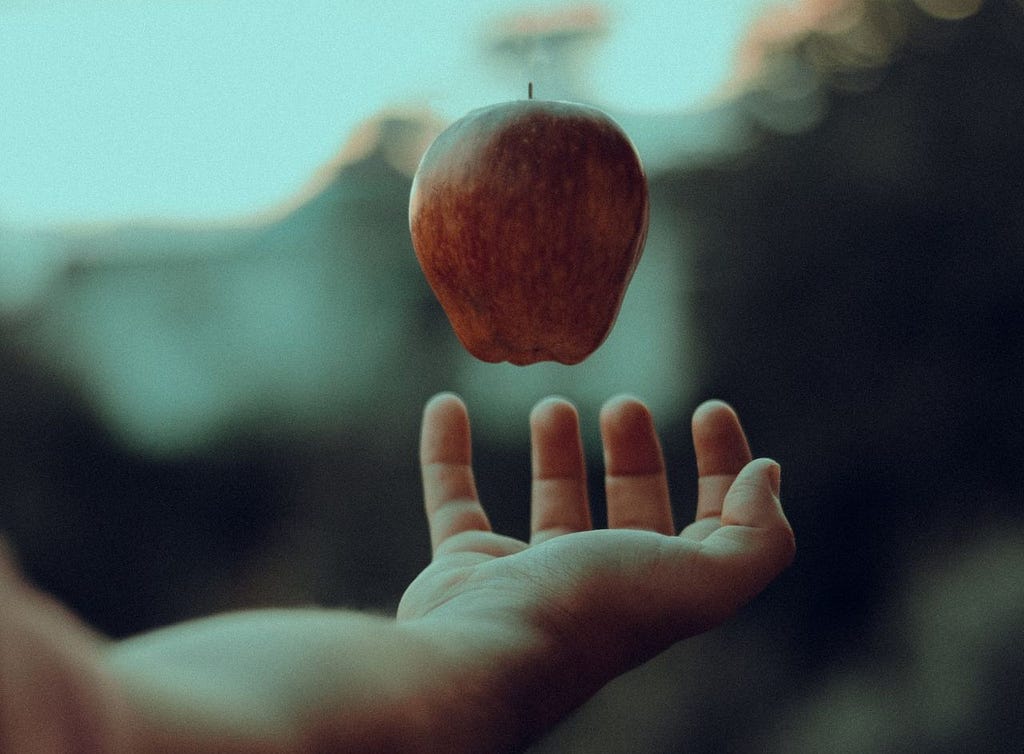
We use gravity every day. In fact, life wouldn’t be possible without it, and yet we still don’t fully understand it. Or do we? Let’s find out.
What is gravity? To put it simply, gravity is what keeps us on the ground, the Moon in the sky, and the planets in their orbits. According to Newton, gravity is a force — an attractive force between two bodies. Its strength depends on the masses of the objects and the distance between them: the more massive the objects and the closer they are, the stronger the pull.
Gravity is a force. Simple, case closed. Is it? Well, Einstein would not agree, and neither does his general theory of relativity. Gravity was indeed considered a force until 1915, when Einstein showed that gravity is not a force at all but the geometry of spacetime: a massive object bends spacetime, and any nearby object moving through that curvature experiences what we call gravity. But I’m getting ahead of myself; allow me to explain.
Think of an ordinary bedsheet. Stretch it out flat and place a soccer ball in the middle; it creates a dip in the sheet. Now add a tennis ball nearby; it rolls toward the soccer ball, following the dip. That is gravity: nothing more, nothing less — according to our best understanding today, courtesy of the general theory of relativity.
So now we know: gravity is the geometry of spacetime. Case closed? Well, not exactly. Alongside general relativity, there is another branch of physics, arguably even more successful than Einstein’s theory of gravity: quantum mechanics. And quantum mechanics does not play well with our best theory of gravity at all.
Quantum mechanics is the physics of the atomic world. It explains how things behave at the smallest scales, and it is one of the most precisely tested theories we have. The problem is that the two theories are built on foundations that refuse to work together. General relativity describes spacetime as smooth and continuous; quantum mechanics says that at tiny scales, everything is jumpy, uncertain, and quantized. When physicists try to apply the mathematics of quantum mechanics to gravity, the equations break down and give nonsensical results — infinities that cannot be tamed. And in places where both theories matter at once, like the center of a black hole or the very first instant of the Big Bang, neither can give us answers. The expectation is that a deeper theory — a quantum theory of gravity, the holy grail of physics — will one day unite them. Finding it remains one of the biggest open problems in physics.
But why do we even need a quantum theory of gravity? One could argue that where it matters most is at the very extremes — inside black holes or at the birth of the universe — and for almost everything else, we can safely ignore it. After all, we can launch rockets, predict eclipses, and keep our feet on the ground using Einstein’s smooth spacetime. That’s true for now. The trouble is, those “extremes” are not just faraway curiosities; they hold the keys to the deepest questions we can ask. What really happens at the center of a black hole? What sparked the Big Bang? Without a theory that marries gravity and quantum mechanics, those questions remain unanswerable. More than that, at the tiniest scales, the universe itself doesn’t let us ignore the clash: the smooth fabric of spacetime must, at some fundamental level, be woven from quantum threads. Until we understand that stitching, our picture of reality is incomplete — not just in far-off corners, but right here under our feet.
So we are back to square one. We thought we knew gravity until we realized we didn’t. Gravity, one of the most beautiful creations of God, is mysterious in its own unique way. We use it every day. We cannot survive without it. We understand it to some extent, and yet we still don’t fully understand what it is.
After all these advances, theories, and technology, we thought we were close to solving the mystery of gravity, but what we know may well be a single drop in the ocean.
Thank you for reading.